
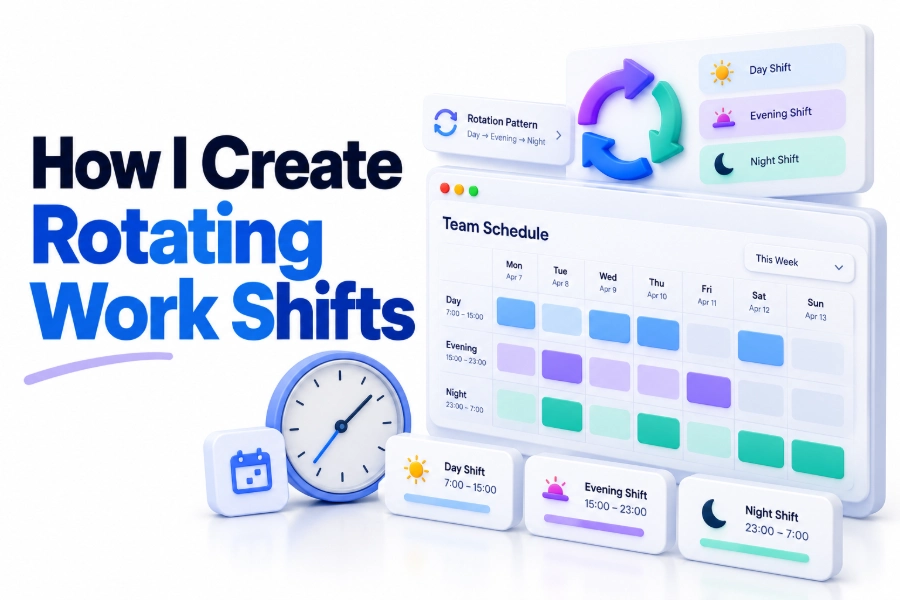
A rotating work schedule shares early, late, night, weekend, or on-call duties among employees instead of assigning the same shift permanently. When people ask how I create rotating work shifts, the practical answer is to begin with coverage requirements, identify employee constraints, choose a predictable rotation pattern, and test the schedule for fairness before publishing it.
The best rotation is not necessarily the most complex or perfectly symmetrical. It is the one that gives the business enough qualified staff at every critical hour while allowing employees to anticipate their working lives. Rest periods, skill coverage, workload, personal availability, and local labor rules all need to shape the final pattern.
This article explains how to calculate staffing demand, select a rotation model, build a repeatable schedule, and manage shift changes without constant confusion. You will also find sample schedules, fairness checks, common mistakes, and troubleshooting advice. The goal is a rotation you can maintain week after week—not a spreadsheet that works once and collapses as soon as someone takes leave.
Planning the Coverage Your Operation Actually Needs
Start with the work, not the employee list. Map the hours during which the organization must operate, then estimate how many people are needed in each time block. A hospital unit may require continuous coverage, while a warehouse might need extra staff only during receiving and dispatch periods.
Avoid assuming every shift requires the same headcount. Review order volumes, customer traffic, production targets, service calls, safety requirements, and historical overtime. Coverage that changes by day or hour should be reflected in the schedule rather than hidden behind one standard staffing number.
Separate minimum coverage from ideal coverage
Minimum coverage is the smallest team that can operate safely and legally. Ideal coverage includes enough capacity for breaks, routine disruptions, training, administrative work, and normal fluctuations. Scheduling only to the minimum makes a rota fragile because one absence can create an immediate staffing emergency.
Document both numbers for each shift. For example, a service desk might require at least two agents overnight but perform better with three on Friday and Saturday. This distinction helps managers decide where overtime, cross-training, or temporary support produces the greatest benefit.
Include skills and responsibilities
Headcount alone does not guarantee usable coverage. Each shift may need a supervisor, first-aid-trained employee, licensed operator, experienced closer, security-cleared worker, or team member who can complete a specialized procedure. Mark these qualifications before assigning names to time slots.
A shift with five inexperienced employees may be less capable than one with three appropriately qualified workers. Treat each required role as a coverage category. This prevents schedules that appear complete on paper but leave the team unable to perform essential work.
Gathering Employee Availability and Scheduling Constraints
Collect availability in a consistent format before building the rotation. Ask employees to identify times they cannot work, times they prefer to work, and any limitations on weekly hours. Separating firm restrictions from preferences makes it easier to protect genuine constraints without treating every request as mandatory.
Set a deadline and a clear process for submitting changes. Informal requests delivered through chats, hallway conversations, and handwritten notes are easy to lose. A standard availability form or scheduling system creates one reliable record and reduces disputes about what was communicated.
Employment contracts, union agreements, company policies, and local labor laws may affect shift length, rest periods, night work, overtime, breaks, and advance notice. Verify the rules that apply to your workplace rather than copying a schedule from another organization. Requirements can differ by location and industry.
Employee availability checklist
- Contracted weekly hours
- Maximum permitted or preferred hours
- Days and times the employee cannot work
- Preferred shifts and voluntary overtime interest
- Required qualifications or certifications
- Approved leave, training, and recurring appointments
- Restrictions on nights, weekends, or consecutive shifts
- Minimum rest periods between assignments
- Transportation limitations for very early or late work
- Any accommodations that affect scheduling
Choosing a Rotating Shift Pattern
Once coverage and constraints are clear, choose a rotation pattern that matches the operating hours. Common options include weekly rotations, rapid rotations every few days, slow rotations lasting several weeks, and team-based cycles in which fixed crews move through a repeating sequence.
Predictability matters more than novelty. Employees should be able to look several weeks ahead and know when their pattern repeats. Frequent exceptions make even a simple rotation difficult to understand, so select the least complicated model that can satisfy your coverage needs.
Weekly rotation
In a weekly rotation, employees work one shift for a week and move to another shift the following week. A three-team operation might rotate from mornings to afternoons to nights. This structure is straightforward to publish and usually easy for managers to administer.
The drawback is repeated adjustment to sleep and family routines. Weekly rotation may feel too fast for employees who need time to adapt to nights, yet too slow for those who dislike remaining on an undesirable shift for seven consecutive days.
Rapid rotation
Rapid rotations change every two or three days. They can distribute unpopular hours more frequently and prevent one team from spending an entire week on nights. Some organizations use patterns such as two mornings, two evenings, two nights, and several rest days.
These schedules require careful fatigue management. Rapid changes can be difficult when employees finish a late shift and return for an early one. Forward rotation—moving from morning to evening to night—is generally easier to organize than repeatedly switching backward.
Slow rotation
A slow rotation keeps employees on the same shift for several weeks before they move. It offers greater short-term stability and gives workers more time to settle into consistent sleep and commuting routines. It may suit operations that value continuity within each shift team.
The tradeoff is that employees remain on less desirable assignments longer. Managers also need a deliberate handover process because habits and responsibilities may become closely associated with one crew during each rotation period.
Fixed shifts with rotating weekends
Not every workplace needs employees to rotate through every time of day. Some teams remain on fixed morning, evening, or night assignments while weekends and holidays rotate. This can provide stable sleep patterns while still sharing the dates most employees prefer to have off.
Fixed shifts work particularly well when employees voluntarily prefer different hours. They become less fair when night or weekend duties repeatedly fall to the same people without agreement, recognition, or appropriate compensation.
Building the Rotation Step by Step
Create the schedule in layers. Begin with required shifts and roles, add known restrictions, and assign the least flexible positions first. Employees with broader availability can then fill the remaining gaps. This is more reliable than assigning everyone quickly and repairing conflicts afterward.
Use a repeatable cycle rather than constructing every week independently. A four-week, six-week, or eight-week template reduces administrative work and makes the schedule easier to explain. Leave requests and unusual demand can be added as exceptions without changing the underlying pattern.
1. Define every shift
List start and finish times, paid or unpaid breaks, and the minimum number of employees required. Include opening, closing, handover, and on-call responsibilities that extend beyond the main operating period.
2. Calculate the hours required
Multiply the number of employees needed by the paid hours in each shift. Compare the weekly total with the contracted hours available across the team. A large gap means the schedule cannot work without hiring, overtime, shorter coverage, or another operational change.
3. Create balanced shift groups
Place employees into groups that contain the necessary skills and experience. Avoid concentrating all senior staff on weekdays or mornings. Each group should be capable of handling routine operations and foreseeable problems without relying constantly on another team.
4. Select a rotation sequence
Choose how groups move between shifts and how long they remain on each assignment. Keep the sequence consistent wherever possible. A visible repeating pattern is easier to follow than a collection of individual assignments with no recognizable logic.
5. Add rest days
Insert rest periods before filling optional shifts or overtime. Check the transition between weeks as well as the days within each week. A schedule can appear acceptable in separate calendar weeks while still creating a short turnaround at the boundary.
6. Apply leave and availability
Add approved leave, recurring restrictions, and planned training. Use qualified substitutes rather than simply placing the nearest available person into a gap. Confirm that reassignment does not create another uncovered shift elsewhere.
7. Review hours and fairness
Calculate total hours, nights, weekends, holidays, and undesirable assignments for each employee. Compare these figures over the full rotation cycle. One week may look uneven even though the complete cycle is balanced.
8. Test and publish
Run the schedule as a pilot when possible, collect specific feedback, and correct recurring problems. Publish the approved version through one official channel. Keep a clear revision record so employees can distinguish the current schedule from earlier drafts.
Creating a Practical Shift Schedule Template
A useful template shows more than names and dates. Include shift times, role assignments, break arrangements, total scheduled hours, and a status indicating whether the rota is a draft or final version. Color can improve scanning, but labels should remain understandable when printed in grayscale.
Build automatic checks into spreadsheet or scheduling software wherever possible. Useful alerts include overlapping assignments, insufficient rest, missing qualifications, excessive consecutive workdays, and hours above contractual limits. Automation should identify problems; the manager still needs to judge whether the resulting workload is sensible.
For broader planning methods, review [Internal Link: Employee Scheduling Best Practices]. A consistent framework makes it easier to compare labor demand with available hours and explain why particular staffing decisions were made.
Simple three-team rotation example
The following example covers three eight-hour shifts. Each team changes assignment weekly and receives scheduled rest days according to the organization’s staffing plan.
Cycle week | Team A | Team B | Team C
Week 1 | Morning | Evening | Night
Week 2 | Evening | Night | Morning
Week 3 | Night | Morning | Evening
Week 4 | Pattern repeats | Pattern repeats | Pattern repeats
This table illustrates the rotation rather than a complete compliant rota. Actual schedules must also account for days off, breaks, leave, weekly hour limits, and relief coverage. A three-team model alone may not provide continuous coverage when every employee needs regular rest days.
Keeping the Schedule Fair Over Time
Fairness does not mean every employee receives identical assignments in every week. It means that comparable employees carry a reasonably balanced share of unpopular duties over a meaningful period. Measure nights, weekends, holidays, short-notice changes, and overtime across the complete cycle.
Preferences can improve fairness without requiring identical treatment. One employee may prefer nights because of childcare arrangements, while another values weekends off. Voluntary differences are useful when they remain genuinely voluntary and do not create unsafe workloads or permanent disadvantages for particular workers.
Use transparent assignment rules
Explain how shifts are allocated before disputes occur. Rules might prioritize contractual availability, required qualifications, rotating holiday lists, seniority provisions, or an equal distribution of weekends. Employees are more likely to accept an undesirable assignment when the method is consistent and visible.
Avoid changing the rules to solve individual complaints. If exceptions are necessary, document why they were made and how similar cases will be handled. Consistency protects both the workforce and the manager responsible for scheduling decisions.
Track fairness with data
Maintain a simple count of night shifts, weekend days, public holidays, overtime hours, and emergency call-ins. Review the totals monthly or at the end of each rotation. Patterns that are difficult to notice on a weekly calendar become obvious when measured.
Numbers still need context. An employee may have fewer night shifts because of an agreed accommodation or more overtime because they volunteered. Use the data to prompt a review, not to erase legitimate differences between individual arrangements.
Managing Fatigue and Shift Transitions
Rotating shifts can affect sleep, alertness, commuting safety, and family life. Avoid scheduling a late finish followed by an early start, even when the separate shifts look normal. Quick turnarounds reduce recovery time and can increase errors, absence, and employee dissatisfaction.
Forward rotations usually move from morning to evening to night. This progression often fits human sleep patterns better than moving repeatedly from nights back to mornings. Whatever sequence you choose, include enough recovery time when employees transition between substantially different working hours.
Long shifts can create more full days off, but they also concentrate fatigue. Twelve-hour schedules may suit some operations and employees, while becoming risky in physically demanding, safety-critical, or highly repetitive work. Evaluate workload and break quality instead of judging the shift only by its length.
Fatigue-reduction tips
- Limit abrupt changes between day and night work.
- Avoid excessive consecutive night shifts.
- Protect rest periods after overtime or emergency call-outs.
- Schedule demanding tasks when staffing and alertness are strongest.
- Ensure employees can take meaningful breaks away from their workstations.
- Watch for recurring errors, lateness, and absence after specific rotations.
- Invite employees to report fatigue concerns without being penalized.
- Review long commutes when assigning very early starts or late finishes.
Handling Shift Swaps, Leave, and Absences
A rotation needs controlled flexibility. Employees should be able to request swaps, but a manager or authorized scheduler should approve them before they take effect. Approval confirms that both workers are qualified, rest requirements remain intact, and the exchange does not create overtime or coverage problems.
Create one process for routine swaps and another for urgent absences. Define who must be contacted, how much notice is expected, where the request is recorded, and who confirms the replacement. A verbal agreement between colleagues should not automatically change the official schedule.
Maintain a relief plan rather than rebuilding the entire rota for every absence. Cross-trained employees, float staff, voluntary overtime lists, part-time availability, and agency support can provide backup. Rank these options in advance so supervisors are not improvising during a busy shift.
For more detail on preparing employees to cover multiple roles, see [Internal Link: Cross-Training Employees]. Cross-training expands the pool of suitable replacements, but competence must be verified before someone is scheduled independently.
Communicating and Publishing the Rota
Publish schedules far enough in advance for employees to arrange transport, childcare, appointments, and personal commitments. The appropriate notice period depends on local rules and workplace policy, but consistency is essential. A regular publication day gives employees confidence that the schedule is being managed deliberately.
Use one authoritative location, such as a scheduling platform, employee portal, or controlled spreadsheet. Messages and printed copies can serve as notifications, but they should point back to the official version. Multiple uncontrolled copies make it difficult to know which rota is current.
Mark every revision with the date, time, and person who approved it. Notify affected employees directly when their shifts change instead of expecting them to notice an updated cell. For significant changes, request confirmation so the manager knows the revised assignment has been seen.
Communication checklist before publication
- All required shifts have enough qualified staff.
- Contracted hours and overtime totals have been checked.
- Leave, training, and availability restrictions are included.
- Rest periods and consecutive workdays have been reviewed.
- Shift swaps have received formal approval.
- The schedule is clearly labeled as draft or final.
- Employees know where the official version is stored.
- Changes since the previous version are identified.
- A named contact can answer scheduling questions.
Common Rotating Schedule Mistakes
The most common error is designing a mathematically neat schedule that ignores real working conditions. Equal numbers of shifts do not guarantee equal strain. A busy Saturday night may be more demanding than several quiet weekday evenings, and repeated short turnarounds may be worse than one additional shift.
Another mistake is using overtime to conceal a permanent staffing shortage. Occasional overtime can solve a temporary gap, but recurring overtime signals that available labor does not match required coverage. Redesigning the rota cannot create hours that the workforce does not have.
Building around individuals instead of roles
Starting with employee names encourages the scheduler to fill visible spaces without confirming operational needs. Define positions, qualifications, and coverage levels first. Assign people only after the structure of each shift is clear.
This approach also makes absence planning easier. When someone calls out, the manager can search for a replacement who meets the role requirements instead of choosing any employee who happens to be free.
Making the pattern too complicated
Complex cycles are sometimes necessary, especially in continuous operations, but every additional exception creates administrative risk. Employees should be able to explain their rotation and identify their next assignment without decoding a maze of colors, abbreviations, and footnotes.
Simplify repeated variations where possible. If individual arrangements make the master rota unreadable, record them as clearly labeled exceptions rather than altering the core pattern for everyone.
Ignoring the handover period
When one shift ends at the exact moment another begins, employees may have no paid time to exchange information. Critical updates then become rushed, incomplete, or dependent on unpaid early arrival.
Schedule an overlap or formal written handover when continuity matters. Account for that time in labor calculations. Handover is operational work, not an invisible activity that can be added without resources.
Testing and Improving the Rotation
Run a new rotation for a defined trial period, usually long enough to complete at least one full cycle. Tell employees which elements are fixed and which are being evaluated. This prevents every personal preference from being treated as a design failure while still inviting useful operational feedback.
Measure coverage gaps, overtime, absence, lateness, swap requests, missed breaks, and errors. Ask employees which transitions are hardest and why. Specific feedback such as “the Sunday night-to-Tuesday morning change allows too little recovery” is more actionable than a general statement that the schedule is unfair.
Make changes at cycle boundaries when possible. Constant mid-cycle adjustments reduce predictability and make results difficult to compare. Correct immediate safety or compliance problems at once, but group ordinary refinements into planned revisions with clear effective dates.
Practical signs the rotation needs revision
- The same shifts repeatedly require overtime.
- Employees frequently request the same type of swap.
- Qualified coverage depends on one or two individuals.
- Short-notice absences cluster after certain transitions.
- Breaks are routinely missed on specific days.
- Staff regularly exceed contracted or permitted hours.
- Managers maintain unofficial side schedules to make the rota work.
- Employees cannot predict their shifts beyond the next published week.
Alternatives to Full Shift Rotation
Permanent shifts may be better when enough employees genuinely prefer mornings, evenings, or nights. Stable assignments reduce sleep disruption and simplify personal planning. Fairness can still be maintained by rotating weekends, holidays, standby duties, or other less desirable responsibilities.
Self-scheduling is another option. Managers publish staffing requirements, employees request available shifts, and unresolved gaps are assigned according to predefined rules. This gives workers more control, but it requires deadlines, qualification checks, and a fair method for distributing unpopular times.
Hybrid scheduling combines a stable core assignment with limited rotation. Employees might remain on one shift for several months, rotate only seasonally, or cover occasional nights through a voluntary pool. This model can balance operational flexibility with more predictable routines.
Alternative | Best suited to | Main limitation
Permanent shifts | Teams with strong time-of-day preferences | Unpopular shifts may be difficult to fill
Self-scheduling | Reliable teams with flexible availability | Popular shifts can attract too many requests
Hybrid rotation | Operations needing limited flexibility | Rules can become complicated without firm boundaries
Compressed workweek | Suitable roles with longer workdays | Fatigue may increase during extended shifts
Relief pool | Organizations with variable absences or demand | Requires enough cross-trained backup employees
Conclusion
A reliable rotating schedule begins with a clear picture of the work: operating hours, demand by time period, minimum staffing, and the skills required on every shift. Employee preferences matter, but they need to be considered alongside contracts, rest requirements, leave, fatigue, and the realities of maintaining safe coverage.
The most practical approach is to choose a simple repeating cycle, build balanced teams, add rest days before optional overtime, and review the entire rotation rather than judging isolated weeks. Publishing early, controlling shift swaps, and maintaining one official version prevents many avoidable disputes.
When deciding how I create rotating work shifts, I treat the first rota as a tested operating plan rather than a finished calendar. Measure overtime, absences, missed breaks, difficult transitions, and repeated swap requests. Those signals show where the design needs improvement. A strong rotation will not satisfy every preference on every date, but it should be predictable, explainable, legally appropriate, and reasonably fair over time.
Frequently Asked Questions
How far in advance should rotating shifts be published?
Publish shifts as early and consistently as possible, while meeting applicable notice rules. Many teams benefit from seeing several weeks ahead because employees need time to arrange transport, childcare, appointments, and personal commitments.
What is the fairest rotating shift pattern?
The fairest pattern distributes undesirable duties reasonably over the complete cycle while respecting voluntary preferences and legitimate restrictions. Track nights, weekends, holidays, overtime, and short-notice changes rather than relying only on total scheduled hours.
Should work shifts rotate forward or backward?
Forward rotation from mornings to evenings to nights is often easier on employees than backward rotation. The schedule must still provide adequate recovery between shifts, particularly when moving between daytime and overnight work.
How many employees are needed for rotating shifts?
The number depends on coverage hours, employees required per shift, contracted hours, days off, leave, and relief needs. Calculate total weekly labor hours first, then compare them with the usable hours available from qualified staff.
Can employees exchange rotating shifts?
Yes, when workplace policy permits it and an authorized person approves the exchange. The replacement must be qualified, and the swap must not violate rest requirements, hour limits, overtime rules, or minimum staffing levels.